
The Loyalty ROI Gap: 40% of Restaurant Brands Measure Nothing — Here’s How to Fix That
You have a loyalty program. You’re paying for the platform, running the campaigns, watching sign-ups accumulate. And somewhere in the back of your mind, you suspect it’s working — but you can’t actually prove it.
That suspicion is more widespread than the industry wants to admit.
The RLS 2026 Restaurant Loyalty Frontier report, based on interviews with leaders from 53 restaurant chains, delivers a diagnosis that is both clarifying and alarming: 40% of restaurant brands do zero ROI measurement on their loyalty programs. Another 35% measure only at the campaign level. Just 15% — almost exclusively enterprise-scale operators — achieve full program-level ROI visibility.
Three out of four restaurant brands either measure nothing at all, or measure the wrong things. In an industry where margin pressure is relentless and every budget line is scrutinized, loyalty is largely running on faith.
This post is for CMOs, VPs of Marketing, and Directors of Loyalty who are done guessing. We’ll diagnose why the measurement gap is worse than you think, expose the flaws in how most brands “measure” loyalty today, and deliver a practical four-step framework for getting to real restaurant loyalty ROI visibility — starting now.

Why Are 40% of Restaurant Brands Still Flying Blind on Loyalty ROI?
Most restaurant brands aren’t ignoring loyalty ROI out of indifference — they’re measuring something. Open rates. Redemption counts. Campaign lift. The problem is that measuring something is not the same as measuring the right thing. And in loyalty, measuring the wrong things can be more dangerous than measuring nothing at all — because it creates a false sense of accountability.
The RLS 2026 report is candid about why the gap persists. As one CMO told the report’s researchers:
“I’ve not done deep ROI analysis on anything. I feel like loyalty is table stakes we just need to have.”
— CMO, fast casual chain
That quote captures the systemic rationalization at work across the industry. Loyalty exists because competitors have it — not because brands can demonstrate its value. And the barriers to better measurement are real: 45% of operators cite a lack of staff or analytical capacity, and 35% cite technology limitations as their primary obstacles.
Campaign-level ROI is not program-level ROI. This distinction matters more than most brands realize. Measuring whether a double-points promotion drove incremental transactions over a two-week window tells you something narrow and useful. It tells you nothing about whether the loyalty program, as a whole, is increasing visit frequency across the full member base over six months. Campaign metrics are the tree. Program ROI is the forest.
Without measurement, there’s no accountability. Without accountability, there’s no optimization. Without optimization, loyalty stays a cost center rather than a growth engine — and when budget cycles come around, it’s the first thing that gets cut. Understanding what a measurable, high-performing loyalty program requires is the first step toward closing that gap. But before the fix, there’s a second layer of the problem worth confronting — because even the brands that are measuring are often measuring data they can’t trust.
Why Don’t Restaurant Brands Trust Their Loyalty ROI Numbers?
There’s a well-worn pattern in the industry. A brand signs with a loyalty platform. The dashboard reports impressive ROI — sometimes as high as 14x. Someone shares the number in a leadership deck. Then, when someone tries to reconcile it against the P&L, the numbers don’t add up.
According to Restaurant Business Online, loyalty providers sometimes advertise up to a 15% lift from their programs — while omitting the inputs that matter most to restaurant economics. When operators run their own calculations and account for food costs, discount value, platform fees, and operating costs, the typical result lands significantly lower. One CMO captured the sentiment precisely:
“Even if [the vendor] did provide a number and it was positive, I would not believe it.”
— CMO, fast casual chain
What vendor ROI figures typically omit: the food and beverage cost of every reward redeemed, the discount value given away in promotional offers, platform licensing fees, and the marketing spend required to drive enrollment. When these inputs are added back, the ROI multiple shrinks considerably. A 1.5x–3x independently verified ROI is not a failure — it’s an honest baseline from which to optimize.
This is why tracking the right performance inputs — not just the metrics your platform surfaces by default — separates brands genuinely optimizing their loyalty programs from those simply paying for a dashboard.
The trust gap compounds a deeper structural problem: even when brands decide to measure properly, proving that loyalty is actually causing behavior change turns out to be far harder than it looks. This is the incrementality problem — and it’s where measurement goes from a resource gap to a data architecture gap.
The core issue: 80% of restaurant transactions come from non-loyalty customers. When a brand compares loyalty member behavior to the general population, it’s comparing a self-selected group of behaviorally distinct guests against an opaque, largely anonymous majority. The comparison looks good — but it doesn’t prove the loyalty program caused anything. Customers who join loyalty programs already tend to be frequent visitors. Attributing their behavior to the program without rigorous controls will almost always produce an inflated picture.
“Without a CDP, I can’t compare members and non-members. There is no baseline.”
— Senior Director of Loyalty, 200-unit QSR (via Restaurant Business Online)
The CDP/CRM layer is the infrastructure that makes before/after enrollment analysis possible — connecting pre-enrollment transaction history to post-enrollment behavior at the individual guest level. Operators using CDPs who measure this properly find that loyalty members’ annual spending doubles or triples post-enrollment. The programs are working. The problem is the inability to see it. With the full diagnostic in place, the path forward is practical and achievable.
What Does a Practical Loyalty ROI Measurement Framework Actually Look Like?
Most ROI frameworks start with outputs — revenue lift, redemption rates, member count. This one starts with architecture, because without the right foundation, output metrics are built on sand.
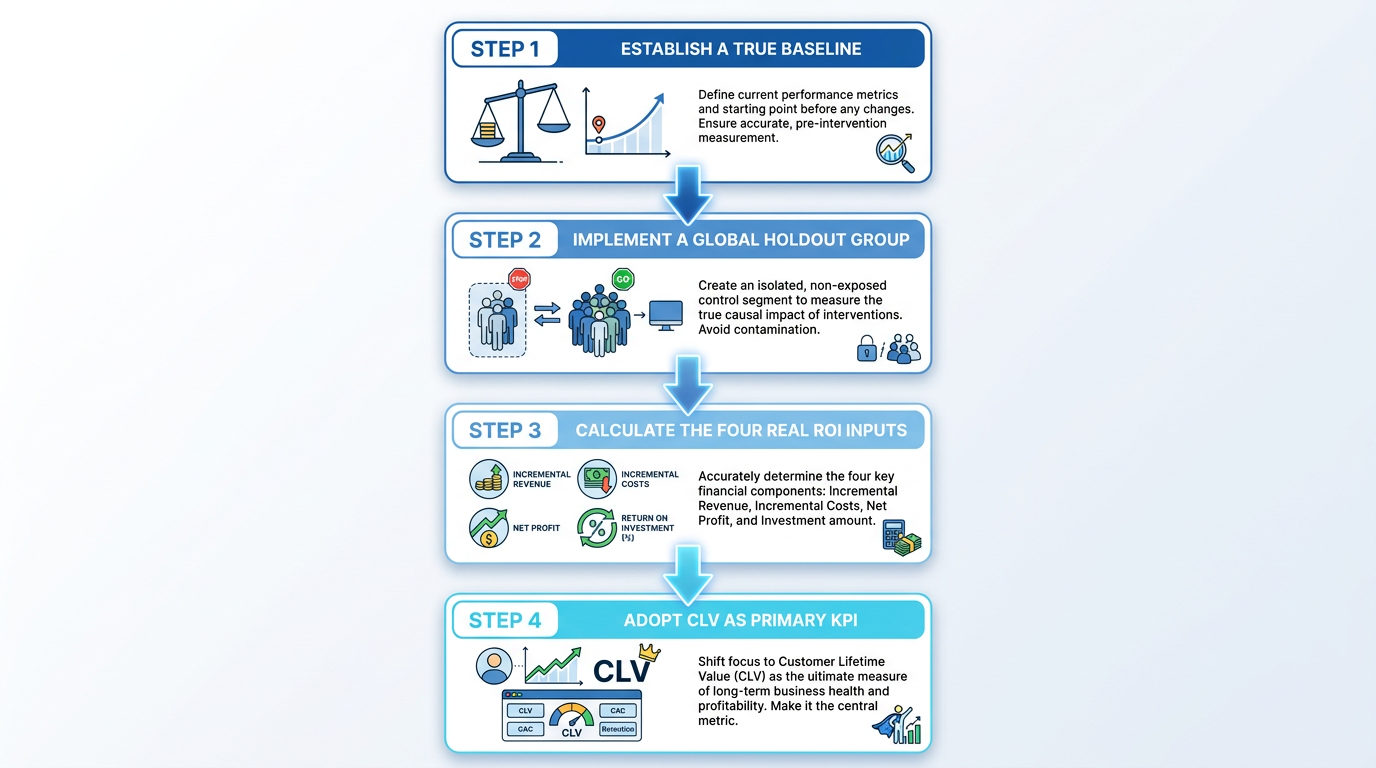
Step 1 — Establish a True Baseline. Stop measuring loyalty ROI from the moment someone enrolls. If possible, track pre-enrollment behavior — even 30–60 days of transaction history per member — using payment method or phone number data. If pre-enrollment data isn’t available, establish non-member benchmarks: average visit frequency, average order value, and 90-day retention rate for your anonymous guest population. This is your control baseline. A CDP/CRM is the foundational requirement for this step — the only infrastructure that can stitch together cross-channel transaction data at the individual guest level.
Step 2 — Implement a Global Holdout Group. Set aside 5–10% of your loyalty member base as a “global holdout” — enrolled members who receive no marketing communications for a defined test period (90 days recommended). Compare the holdout group’s visit frequency, spend, and retention against the general member population. The behavioral delta is what your marketing is actually driving. This is the only methodology that removes selection bias from the calculation — and it’s used by the same 10% of brands that have achieved full program-level ROI visibility.
Step 3 — Calculate the Four Real ROI Inputs. Most vendor dashboards report revenue lift. Genuine loyalty ROI requires four inputs: (1) incremental revenue generated by loyalty members above baseline, (2) minus food and beverage cost of rewards redeemed, (3) minus discount value of promotional offers, (4) minus platform fees and program operating costs. Express the result as both a ROI multiple and an absolute dollar figure. If the number lands between 1.5x and 3x, that’s an honest, defensible baseline — not a failure.
Step 4 — Adopt CLV as the Primary Loyalty KPI. The RLS 2026 report confirms that Customer Lifetime Value is cited as the definitive loyalty benchmark — and is almost never actually tracked. The formula is straightforward: (average order value × visits per year) × average customer lifespan in years. Track it separately for loyalty members and non-members. The delta is the clearest, most defensible statement of your program’s long-term value creation. Loyalty Pulse is built specifically to structure this kind of funnel-level performance visibility — Acquire, Activate, Engage, Retain, Drive Revenue — without requiring manual exports or a dedicated analytics team.
How Do You Turn Measurement Into a Sustained Operational Advantage?
Having the framework is necessary. Executing it consistently is different — and it requires being honest about what separates the 15% of brands with full ROI visibility from the 85% without it.
The brands with full program-level ROI visibility share one structural characteristic: a unified data layer connecting POS, digital ordering, loyalty activity, and marketing engagement at the individual guest level. Without this unification, every measurement attempt becomes an aggregate comparison — and aggregate data flatters your program regardless of what it’s actually doing. Individual-level data tells you the truth.
What good measurement infrastructure enables operationally goes beyond quarterly ROI reports. It enables early identification of members who are disengaging — seeing that a guest who visited twice a week is now visiting once every three weeks, and intervening before the relationship breaks. Churn management is the downstream capability that measurement unlocks. You can’t save guests you can’t see leaving.
It also enables location-level loyalty performance comparisons — one of the most underutilized capabilities in multi-unit restaurant brands. If your program is driving strong CLV lift at 40 of your 60 locations but underperforming at the other 20, that gap is almost certainly operational in origin. Without location-level measurement, you’d never know the problem exists.
The organizational habit to build alongside the infrastructure is equally important: quarterly loyalty ROI reviews using the four-input calculation from the framework. Not weekly redemption reports. Quarterly program reviews that treat loyalty ROI the way a well-run restaurant operation treats food cost — as a core operating metric reviewed at the leadership level.
The true cost of unmeasured guest churn extends far beyond lost transaction revenue. It includes the cost of reacquiring a guest who could have been retained and the compound CLV loss of a relationship that quietly ended. Measurement isn’t about proving a program worked. It’s about seeing the program clearly enough to make it work better.
The Gap Is Closable — But Only If You Start Measuring the Right Things
The three-part diagnosis is worth stating plainly. First: 40% of brands measure nothing, leaving loyalty running on intuition and competitive pressure. Second: the numbers most brands do see are vendor-inflated — excluding the cost inputs that matter to actual restaurant economics. Third: the incrementality problem makes true ROI invisible without the right methodology and data infrastructure.
The good news: the gap is closable. The four-step framework — baseline establishment, global holdout groups, true four-input ROI calculation, and CLV as the primary KPI — gives any brand a concrete starting point regardless of where they are today.
Here’s a challenge to close on. Can you answer these three questions right now, with data you trust?
- What is your loyalty program’s true ROI after accounting for food costs, discount value, and platform fees?
- How does your loyalty members’ CLV compare to non-members — and to their own pre-enrollment behavior?
- Are members visiting more frequently because the program changed their behavior, or because they were already your best guests?
If you can’t answer all three, you have a measurement gap to close. The brands that close it first will prove loyalty’s value, defend their budgets with data, and build the organizational muscle to keep optimizing. The ones that don’t will keep paying for programs they can’t explain — until someone asks them to.
See Whether Your Loyalty Program Is Actually Driving Growth — Or Just Activity
Loyalty Pulse gives restaurant teams clear, structured visibility into loyalty performance — member by member, location by location, without spreadsheets or manual exports.
