
Every restaurant marketer has sat in that room. The one where someone puts “right message, right guest, right time” on a slide and everyone nods. The vision is clear, the language is familiar, and the aspiration is nearly universal. Then Monday morning arrives, the campaign calendar is due, and the team does exactly what it did last month — exports the full list, writes one subject line, picks one offer, and hits send.
This is not a failure of imagination. It is the state of the industry.
According to the RLS 2026 Restaurant Loyalty Frontier report — based on in-depth interviews with more than 50 senior loyalty practitioners across QSR, Fast Casual, and Casual Dining — 75% of restaurant brands still rely on batch-and-blast mass communications. Three out of four. The same email. The same offer. Delivered to every guest on the list, whether they visited yesterday or haven’t placed an order in eight months.
The operators living this reality are not naive. They know exactly what they want:
“Our reality right now is the batch and blast, right? Where we’re sending our perceived notions of a strong offer to each one of our guests… our hopes and dreams are to get to a place where we’re actually being able to hit you based on your behavior.”
— VP of Loyalty, QSR (RLS 2026 Restaurant Loyalty Frontier)
This blog is not another aspirational take on what personalization could look like. It is a practical diagnostic rooted in real industry data. We’ll break down exactly what batch-and-blast marketing means in the context of a restaurant loyalty program, why three-quarters of the industry remains stuck in it, what it’s actively costing brands in lost revenue and eroding retention, and the concrete path forward — step by step, including how AI is making that path operationally viable for lean teams.
If you are a VP of Marketing, Director of Loyalty, or CMO who has lived this frustration firsthand, this one is for you.
What “Batch and Blast” Really Means in Restaurant Loyalty
The term gets thrown around constantly in loyalty circles, but it is worth defining precisely — because the problem is more specific, and more pervasive, than most operators realize.
Batch and blast means one message, one offer, sent to the entire loyalty list at once, regardless of who is on that list. It does not account for how often a guest visits. It does not factor in what they order, which channels they prefer, when they last engaged, or how much they typically spend. Every guest is treated as a single, undifferentiated entity — and the brand’s best guess at a compelling offer goes to all of them simultaneously.
This is not merely a missed personalization opportunity. It is a structural mismatch between what the guest data knows and what the marketing system does with it.
The Segmentation Reality: 80/20 in the Wrong Direction
The RLS 2026 Restaurant Loyalty Frontier report found that 80% of restaurant loyalty programs operate on macro-segmentation alone — broad behavioral buckets like Active, Lapsed, and New Guest. Only 20% use micro-segmentation based on behavioral signals like visit frequency tiers, order occasion patterns, spend level bands, or menu category preferences.
To understand what that gap looks like in practice, consider a real-world scenario. A brand runs a “We miss you” win-back campaign targeting its Lapsed segment. Into that campaign go two very different guests: one who visited the location three times in the past two weeks but somehow missed the loyalty program’s activity threshold, and another who genuinely hasn’t placed an order in eight months. Both receive the exact same email. Both get the same offer. One of them needed no offer at all — and the brand just trained them to wait for a discount. The other needed a fundamentally different message than what a generic “We miss you” can deliver.
Macro-segmentation feels like segmentation. In practice, it’s barely better than blasting the whole list.
Channel Blindness: When More Channels Make the Problem Worse
The segmentation problem is compounded dramatically by how brands handle channel distribution. According to the RLS data, more than 90% of restaurant loyalty programs hit all available channels simultaneously, regardless of individual guest preference. Push notification, email, SMS — all of them, all at once, to everyone.
Fewer than 10% of brands use channel preference segmentation — the practice of routing messages based on which channel each guest actually engages with. The result is predictable: guests who only respond to push notifications are being trained to ignore their email inbox. Guests who prefer SMS are experiencing notification fatigue from push alerts they never open. The volume feels like reach. In reality, it’s friction.
Product-Offer Blindness: Guessing Instead of Knowing
Perhaps the starkest data point in the entire RLS report concerns product-level personalization. Fewer than 15% of restaurant loyalty programs execute automated product-propensity offers — meaning offers based on a guest’s actual order history, basket composition, or item affinities.
The other 85% are promoting what the brand wants to push, not what the guest is already inclined to buy. This is not just a missed revenue opportunity; it’s a signal to the guest that the brand doesn’t actually know them. And in 2026, that signal carries a cost.
This gap between what’s possible and what’s practiced is exactly what traditional versus modern loyalty approaches were designed to close. The evolution from legacy, campaign-calendar-driven loyalty to behavioral, data-activated loyalty is not a future state — it’s available right now. The question is why so few brands have made the crossing.
That question is exactly what the next section answers — because the gap isn’t a knowledge problem. It’s a structural one.
Why 75% of Restaurant Brands Are Still Stuck on Mass Messaging
Understanding that batch and blast is widespread is one thing. Understanding why it’s still so widespread — in 2026, with the data and tools available — requires a more honest conversation. The operators in the RLS study know what they want. They’ve said it clearly. The aspiration for behavioral personalization is nearly universal. So what’s actually blocking it?
“Everyone’s been talking about one-to-one for forever. The data is there, and technically we have the ability to do it, but it’s actually much harder in practice.”
— VP of Marketing, Casual Dining (RLS 2026 Restaurant Loyalty Frontier)
The answer is not a lack of ambition. It’s a set of three structural barriers that collectively make personalization operationally out of reach for most restaurant marketing teams, regardless of how clearly they see the destination.
Barrier One: Lack of Staff and Resources (45% of Operators)
The most commonly cited barrier — named by 45% of operators in the RLS study — is the sheer human capacity required to execute personalized marketing at meaningful scale.
Here’s the math that breaks most teams: one batch-and-blast campaign is one execution. One email, one offer, one send. For a team of two or three marketers managing a full campaign calendar, that is manageable. But true behavioral segmentation doesn’t produce one execution — it produces twelve, twenty, or fifty. Each micro-segment needs tailored copy that reflects its behavioral context. Each offer needs to be calibrated to the segment’s value and visit frequency. Each creative execution needs to align with the message. And then it needs to go to the right channel, at the right time, for each guest individually.
This is not a creative challenge. It is a calendar impossibility. A lean restaurant marketing team running on manual workflows simply cannot produce fifty personalized campaign executions per month without either burning out or abandoning the rest of the marketing agenda. Personalized campaigns aren’t difficult because operators don’t know how to do them — they’re difficult because the marginal cost of each additional segment is enormous when everything is done by hand.
Barrier Two: Technology Limitations (35% of Operators)
The second major barrier, cited by 35% of operators, is the technology stack itself. Most restaurant brands have assembled their marketing infrastructure over years, adding tools as needs emerged — a POS here, a loyalty platform there, an email tool, a CRM. The result is a fragmented system where data lives in disconnected silos that don’t talk to each other in real time.
Without a unified guest view, personalization decisions become guesswork. You cannot personalize a guest’s fifth-visit offer if you can’t see their first four visits in the same place where you build the campaign. You cannot optimize channel routing if your channel data and your behavioral data live in separate platforms that sync weekly — or not at all.
This is precisely why the infrastructure layer — a CDP/CRM that turns guest data into actionable intelligence — is not a luxury feature for sophisticated operators. It’s the prerequisite for any meaningful personalization. Without it, every personalization initiative hits the same wall: incomplete data at the moment of decision.
As Deloitte’s research on restaurant loyalty programs confirms, data management challenges and technology integration complexity are consistently among the top barriers preventing restaurants from delivering on personalization at scale. The consumer expectation for tailored experiences has outpaced the infrastructure most brands have in place to deliver them.
Barrier Three: Data Quality and Availability (20% of Operators)
Even when technology is present, the underlying data is frequently incomplete. 20% of operators in the RLS study identified data quality and availability as their primary barrier — and this number almost certainly understates the actual prevalence of the problem.
If most of a brand’s transactions are anonymous — cash payments, unidentified digital orders, guest checkout in the app — then the behavioral foundation for personalization is simply empty. You cannot build a product-propensity model for a guest whose order history you’ve never captured. You cannot trigger a win-back sequence for a lapsed guest you can’t identify.
Even enrolled loyalty members frequently have incomplete profiles. If a member makes ten purchases but five of them were through a third-party delivery platform that doesn’t surface item-level data back to the brand, half of that guest’s behavioral signal is invisible. As explored in why first-time guests never return, the data visibility problem is often most acute at exactly the moment when intervention would matter most.
The three barriers reinforce each other in a compounding cycle: a small team can’t build proper data infrastructure → disconnected technology produces incomplete behavioral data → incomplete data makes it impossible to justify investment in better tools → the small team continues operating on batch and blast. Breaking this cycle requires addressing all three barriers simultaneously, not sequentially.
Now that the structural reality is clear, the stakes need to be made concrete. Understanding why the industry is stuck is valuable — but understanding what staying stuck costs is what moves decision-makers to act.
What the Personalization Gap Actually Costs Your Restaurant
Abstract arguments about personalization rarely change budgets. Data does. And the data on the cost of batch-and-blast complacency in 2026 is not subtle.
Consumer Loyalty Is More Fragile Than It’s Ever Been
According to the 2026 Tillster Phygital Index Report, 45% of consumers changed their favorite restaurant chain in the past year — up from 33% in 2025. That is a dramatic acceleration in brand switching behavior, happening in a single twelve-month window. Nearly half of the guests who were loyal to a restaurant last year are not loyal to the same restaurant today.
This statistic reframes the personalization conversation entirely. It’s not about delivering a delightful experience on top of a stable retention base. The retention base itself is eroding. Brands that are relying on inertia — on guests continuing to visit because they always have — are exposed in a way they weren’t even two years ago. And batch-and-blast marketing, with its generic offers and one-size-fits-all messaging, is not the kind of relationship-building that survives competitive pressure.
To make matters more urgent, that same report found that 28% of diners now express dissatisfaction with loyalty programs — nearly double the 15% recorded in 2025. Loyalty programs are not just failing to differentiate brands; in many cases, they’re actively generating dissatisfaction. Irrelevant messaging at high frequency is a primary driver of that erosion.
The Revenue Differential Is Real and Measurable
The financial case for personalization is not theoretical. Loyalty program members who receive relevant, behaviorally tailored communications tend to spend significantly more per visit than those receiving generic mass messaging. When rewards and offers are tied to a guest’s actual behaviors and preferences, visit frequency increases substantially — with automated loyalty approaches associated with a 35% increase in repeat visits within 90 days of enrollment compared to manual systems.
Think about what that means at scale. Across a loyalty base of 500,000 members, moving even a fraction of lapsed guests back to active status through personalized win-back sequences represents meaningful incremental revenue. And the comparison isn’t between personalization and nothing — it’s between personalization and the cost of the batch-and-blast offer that was going to everyone anyway.
The Hidden Cost of Churn Is Almost Always Underestimated
When a high-value guest quietly disengages from a loyalty program, the visible cost is one missed visit. The actual cost is the entire forward lifetime value of that relationship. A guest who visited twice a month and spent an average of $22 per visit, disengaging permanently at age 35, represents a loss that no reasonable analysis would justify ignoring — yet most brands do exactly that, because the churn is invisible.
The true cost of guest churn compounds further when you account for the acquisition cost of replacing that guest. The personalized win-back sequence that would have kept them — a timely, behaviorally relevant offer delivered at the precise moment they were beginning to drift — almost always costs a fraction of what their departure actually costs the business.
Channel Fatigue Is a Self-Inflicted Wound
When over 90% of brands blast all channels simultaneously without preference logic, they’re not expanding reach — they’re compressing relevance. Guests who receive the same message through push, email, and SMS on the same day, for an offer they have no interest in, are not being retained. They’re being trained to tune out.
Channel fatigue is cumulative. Every irrelevant message makes the next message — even a genuinely compelling one — slightly less likely to be opened. Brands that treat channel breadth as a substitute for channel intelligence are actively degrading the long-term effectiveness of their communications, regardless of how good the content becomes.
The Competitive Compounding Problem
Brands that are building genuine personalization capability today are not just improving their current retention metrics. They’re building a first-party data asset that compounds in value over time. Every identified transaction enriches the guest profile. Every behavioral signal improves the predictive accuracy of future offers. Every successful personalized campaign generates data that makes the next campaign better.
Brands still operating on batch and blast are not building this asset. And the gap between those who are and those who aren’t grows wider every month. Understanding what a high-performing loyalty program should actually look like is the first step toward building one.
“45% of consumers say their favorite restaurant chain has changed in the last year.”
— 2026 Tillster Phygital Index Report
The cost of inaction is not abstract — it’s accruing daily. The next section turns from diagnosis to prescription: what the path from batch and blast to behavioral personalization actually looks like, framed not as a binary switch but as a practical maturity journey with meaningful returns at every step.
The Path from Batch and Blast to Behavioral Personalization
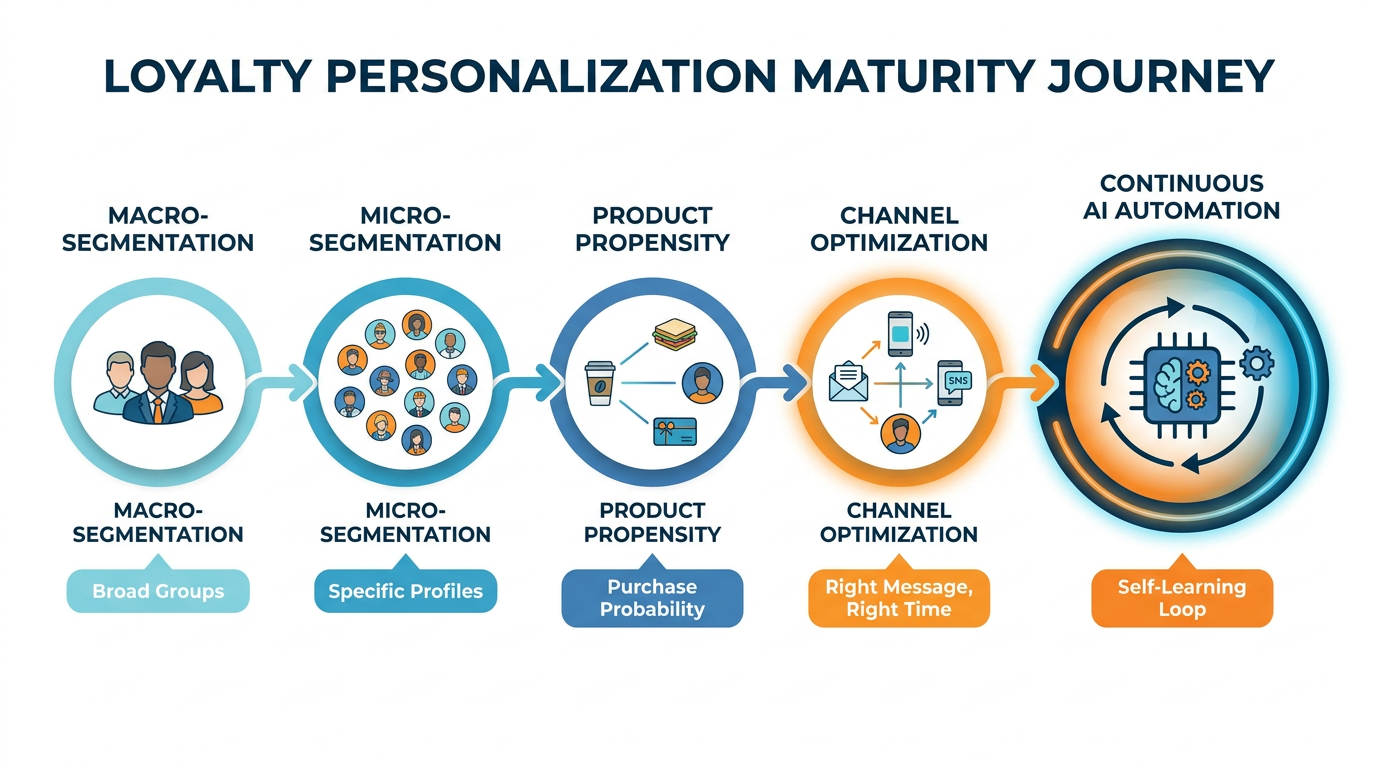
The most important thing to understand about moving from batch and blast to behavioral personalization is that it is not a binary switch. There is no moment where a brand goes from sending one email to everyone to running fully individualized one-to-one communications overnight. There is a maturity journey — and every step along that journey delivers meaningful ROI, even before the destination is reached.
Here’s how that journey actually unfolds, in order.
Step One: Break Your Broad Buckets Into Behavioral Cohorts
The first move is the most accessible, and it doesn’t require a platform rebuild. It requires looking at the data you already have and asking better questions of it.
Most brands have three segments: Active, Lapsed, and New Guest. Start by splitting each of those into behavioral sub-cohorts. Active guests who visit five or more times per month are behaviorally different from Active guests who visit once a month — and they should receive different messages, different offers, and different tones. Lapsed guests who last visited 45 days ago are in a different relationship with the brand than those who haven’t ordered in six months. New guests in their first week are in a critically different window than new guests in their fourth week.
Visit frequency tiers. Spend level bands. Order occasion patterns — lunch regulars versus weekend diners versus late-night visitors. These cohorts don’t require algorithmic sophistication. They require the willingness to segment more precisely before going to market. Immediately, relevance improves. Immediately, offer calibration improves. The campaign calendar gets more complex — but the returns justify the investment almost instantly.
Step Two: Start Promoting What Guests Actually Buy
The second step is eliminating the product-offer blindness that plagues 85%+ of restaurant loyalty programs. This means stopping the practice of promoting what the brand wants to push and starting the practice of promoting what the guest is actually inclined to order.
Even a simple rule-based propensity approach delivers dramatic improvements over generic offers. Guests who have ordered the signature burger in three of their last five visits should receive a burger-related offer — not a blanket discount on their next visit with no menu specificity. Guests who consistently order at lunch should receive a lunch-occasion offer, not a dinner promotion that’s irrelevant to their behavior.
The goal, over time, is to move from manual rule-based propensity to automated, AI-driven propensity — where the platform continuously analyzes each guest’s order history and deploys the most relevant offer automatically, without manual intervention. Incentivio’s AI-powered upsell engine is designed to handle exactly this layer, continuously optimizing offer relevance based on real-time behavioral signals.
Step Three: Route Messages by Channel Preference, Not Channel Availability
Before adding more volume to your communication calendar, optimize where that volume is going. Channel preference segmentation — routing messages based on where each guest actually engages, rather than hitting all channels simultaneously — is one of the highest-ROI, lowest-complexity optimizations available to most restaurant marketing teams.
Look at your data. Which guests open push notifications but never engage with email? Which guests consistently convert via SMS? Which guests have turned off push alerts but read every email? These patterns exist in every loyalty base, and they can be identified without sophisticated AI — just with the willingness to look. Route accordingly. The result is the same number of messages, sent to fewer channels per guest, with dramatically higher engagement rates.
Step Four: Automate Lifecycle Triggers
Win-back sequences. Birthday offers. Post-first-visit onboarding journeys. Lapse alerts at 30, 45, and 60 days. These are not sophisticated personalization — they are the floor. They are table stakes for any loyalty program that wants to function as a retention tool rather than a discount distribution mechanism.
But they are also exactly the kind of campaigns that most lean restaurant marketing teams don’t have time to execute manually on a rolling basis. The answer is not to hire more people — it’s to configure these automations once through a Guest Journey platform and let them run continuously. Every guest who crosses a lifecycle threshold gets the right message automatically, without anyone on the team having to manually pull a list, write an email, and schedule a send.
This automation alone frees significant team capacity — which can then be redirected toward the higher-order strategic work of improving segmentation, creative, and offer strategy. The operational unlock is real, and it compounds over time as more lifecycle automations are configured and refined.
Step Five: Measure Incremental Lift, Not Just Campaign Metrics
Here is one of the most overlooked problems in restaurant loyalty: 40% of brands don’t measure loyalty ROI at all. Not in any rigorous, incremental sense. They track redemptions. They track open rates. But they don’t measure whether the campaign caused behavior — whether members who received a personalized offer visited more than they would have without it.
Without measurement, there is no case for investment. And without the case for investment, the cycle of under-resourcing continues. The solution is to build an incrementality measurement practice — starting with simple holdout testing — so that every campaign generates data that justifies (or improves) the next one. Loyalty Pulse provides exactly this kind of built-in ROI measurement, making the business case for personalization visible and continuous rather than anecdotal.
The five-step path is sound in theory. But one practical question runs through every step: who does the work? For teams that are already stretched to their limit, adding complexity — even with the promise of returns — can feel impossible. The next section addresses that question directly: how AI is the missing operational ingredient that makes this journey viable without requiring a bigger team.
How AI Is Closing the Restaurant Personalization Gap Without Requiring a Bigger Team
The statistic from the RLS 2026 report that should stop every restaurant marketing leader cold is this one: 60% of restaurant brands see AI as the answer to personalization scalability. And yet 51 out of 53 respondents in the same study said they are not ready to launch AI-powered personalization campaigns today.
The aspiration is nearly universal. The readiness is nearly absent. That gap is the most important challenge in restaurant loyalty right now — and it stems from a fundamental misunderstanding of what AI is actually supposed to do in this context.
AI as Executor, Not Feature
Most brands think about AI as a feature to purchase — a checkbox on a platform evaluation scorecard. “Does the platform have AI? Yes.” What that rarely means in practice is that AI is actually executing the operational and analytical work that currently lives on the shoulders of the marketing team.
The real shift is thinking about AI not as a feature, but as an executor. The system that does the analytical and operational work for the team, continuously and automatically, without requiring manual intervention at each step.
When AI is functioning as an executor in a restaurant loyalty context, here is what it is actually doing:
Behavioral segment identification: AI continuously monitors guest behavior and updates cohort assignments in real time — without anyone on the marketing team manually pulling a list. A guest whose visit frequency drops from weekly to biweekly crosses into a different segment automatically, triggering a different communication sequence without manual intervention.
Product-propensity offer generation and deployment: Based on real-time order history signals, AI identifies which offer is most likely to resonate with each guest and deploys it at the moment of highest relevance — without a human having to write a rule for every possible behavioral combination.
Churn prediction and automated win-back: Before a guest fully lapses, AI-powered churn management flags them as at-risk and triggers a personalized re-engagement sequence automatically. The intervention happens at the moment it’s most likely to work — not weeks later when the list is manually reviewed.
Channel intelligence: Over time, the platform learns which channels each guest responds to and routes communications accordingly. Incentivio Connect uses predictive AI to determine not just what to send, but where and when — continuously optimizing for each individual guest’s demonstrated preferences.
Measurement and attribution: AI calculates incremental lift, identifies which segments are responding, and surfaces the insights that inform the next campaign — without requiring a data analyst to run a separate report.
The Capacity Unlock Is Genuine
The operational impact of AI as executor is not incremental. It is transformational for lean teams. A marketing team of two can execute what previously required a team of ten — not by working faster or harder, but by having the platform absorb the analytical and operational complexity that was consuming their time.
This is the point the RLS VP of Marketing quote captures perfectly: “The data is there, and technically we have the ability to do it, but it’s actually much harder in practice.” The hardness is operational, not conceptual. AI solves the operational problem — not by removing human judgment, but by removing human execution from the tasks that don’t require judgment at all.
The Data Infrastructure Is the Foundation
None of this works without the underlying data layer. Every AI-driven personalization decision is only as good as the guest data informing it. This is why the CDP/CRM infrastructure is not a nice-to-have enhancement — it is the foundation on which every downstream personalization capability is built. Every identified transaction enriches the guest profile. Every behavioral signal improves the accuracy of the next prediction. The first-party data asset compounds in value over time, creating a growing intelligence advantage that batch-and-blast brands are not building.
Incentivio’s marketing automation layer sits on top of this data foundation, connecting the intelligence to the execution — translating guest behavioral signals into personalized campaign delivery across every channel, automatically and continuously.
Honest About the Readiness Gap
It would be dishonest to pretend that every brand can flip a switch and immediately operate at full AI-powered personalization maturity. The readiness barriers are real — incomplete data infrastructure, gaps in first-party data capture, and legitimate questions about AI output quality and brand consistency. These concerns deserve to be taken seriously, not dismissed.
The answer is not to wait until conditions are perfect. The answer is to choose a platform where AI is integrated into the workflow natively — not bolted on as an optional module — so that the journey toward AI-powered personalization is incremental, measurable, and grounded in real guest data from day one.
For readers who want the full industry breakdown — the comprehensive analysis of where personalization stands in 2026, what the data says about the path forward, and how AI automation is closing the gap — Restaurant Personalization in 2026: Why 75% of Brands Are Stuck and How AI Automation Is Closing the Gap is the place to go next.
The Invisible Guest Is Your Most Expensive Problem
The gap between what the restaurant industry wants from loyalty and what it is actually delivering is not a strategy gap. The strategies are well understood. The aspiration for behavioral personalization is nearly universal among loyalty leaders. The gap is an execution gap — driven by real, structural constraints in staff capacity, technology infrastructure, and data quality that make the journey from aspiration to execution genuinely difficult.
Three out of four restaurant brands remain on batch and blast not because they don’t care, not because they don’t know better, and not because the business case isn’t clear. They remain there because the tools they’re running require more human capacity to personalize than their teams can provide. Every incremental segment is an incremental execution. And for a team of two or three marketers managing a full calendar, that math doesn’t work.
The brands closing this gap are not necessarily the largest or most well-resourced in the industry. They are the ones that have chosen platforms where AI does the analytical and operational work — where behavioral segmentation, product-propensity offers, churn prediction, and channel routing happen continuously in the background, without requiring a human to execute every step manually.
The guest who walked into your location last Tuesday, placed an order, and left without being recognized or engaged — that guest is the most expensive invisible person in your business. The data to personalize their next visit may already exist in your system. The behavioral signals may already be there. The question is not whether personalization is possible. The question is whether the platform you’re running can turn those signals into action automatically, before that guest becomes a statistic in next year’s consumer switching report.
Stop Sending the Same Message to Everyone.
Incentivio’s intelligent platform does the personalization work your team doesn’t have time to do manually — behavioral segmentation, product-propensity offers, automated churn prevention, and channel intelligence, all running continuously in the background.
